Cows and dogs: why cattle follow a dog, and what to do
Cows follow a dog because they see it as a threat, most of all when they have calves. The Health and Safety Executive names cows with calves and walkers with dogs as the two most common factors when cattle hurt people. Keep your dog on a short lead, give the herd plenty of room and never walk between a cow and her calf. If they come at you, let the dog go and get out of the field.
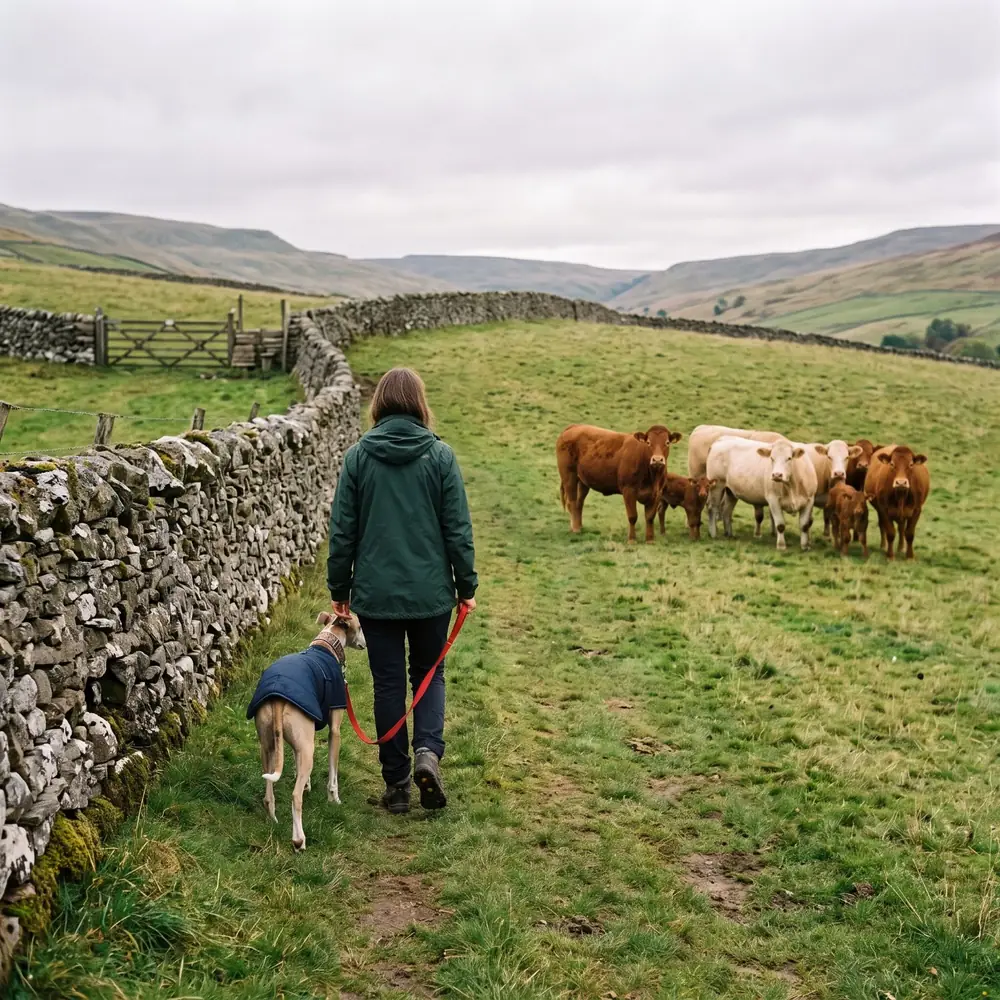
A herd of cows that walks over to look at you is one thing. A herd that comes over because of your dog is another, and most people who walk dogs through fields meet it sooner or later. Cows are not being curious about the dog: they are seeing it off.
Why cattle follow a dog
The Health and Safety Executive's information sheet for farmers puts it plainly. Cattle "with calves at foot can present a risk due to protective maternal instincts, especially when a dog is present", and "even normally placid cattle can become aggressive". Of the incidents it hears about, where cattle hurt people, "the two most common factors in these incidents are cows with calves and walkers with dogs." Read 30 September 2026. HSE, cattle and public access in England and Wales.
The Royal Kennel Club sets it against how often dog walkers meet cattle: there are about 10 million cattle and an estimated 20 billion dog walks a year in the UK, and "fatalities and injuries are rare". Rare is not never, which is why the advice is worth knowing before you are in the field. Read 30 September 2026. The Royal Kennel Club, cattle safety.
What to do in a field of cows
The Countryside Code: "Give wild animals, livestock and horses plenty of space. Their behaviour can be unpredictable, especially when they are with their young and you could get hurt." And "it is good practice wherever you are to keep your dog on a lead around livestock." On open access land and at the coast the lead is required. Read 30 September 2026, from the version last updated 26 May 2023. The Countryside Code.
The Royal Kennel Club's advice adds the practical part: stop, look and listen before you go into a field; keep your dog on a short lead; find a route round the animals that gives them plenty of space, and "never walk between cows and calves." It also says that signs asking you to keep to the path "do not apply when you are trying to protect yourself from injury." Read 30 September 2026. The Royal Kennel Club, cattle safety.
If they come at you, let go
This is the moment the lead comes off, and it goes against every instinct. The Countryside Code: "Let your dog off the lead if you feel threatened by livestock or horses. Do not risk getting hurt protecting your dog. Releasing your dog will make it easier for you both to reach safety." A dog on its own can outrun a cow. You, holding on to a dog, cannot. Read 30 September 2026. The Countryside Code.
Bulls
In England and Wales a farmer may not let a bull of a recognised dairy breed over ten months old loose in a field or enclosure crossed by a public right of way. A bull of another breed over ten months may be there only if cows or heifers are loose in it too. Read 30 September 2026. Wildlife and Countryside Act 1981, section 59. The law on dogs near livestock itself, and what changed in March 2026, is in dogs near sheep and cattle.
How often a walk passes grazing fields
Often. Across the walks we have measured, about 60 per cent run beside grazing fields for half their length or more, and only about one in five passes none at all. Measured 30 September 2026, across about 3.6 million walks.
The numbers
| Beside grazing fields | Share of walks |
|---|---|
| For half the walk or more | about 60% |
| For less than half | about 20% |
| Not at all | about 20% |
A grazing field is where cattle or sheep may be, not where they are today, and nothing on a map says whether the cows in it have calves. So a walk that passes one says "Livestock possible", and what walkers report after they have been is what tells you more. If you tell us your dog cannot cope with livestock, a walk beside grazing fields counts against it when we choose walks for you.
Questions this answers
- Why do cows chase dogs?
- Because they see a dog as a threat, and most of all when they have calves. The Health and Safety Executive says cattle with calves at foot can be a risk because of their protective instincts, especially when a dog is present, and that even normally placid cattle can become aggressive.
- What should I do if cows come towards me and my dog?
- Let your dog off the lead and get out of the field calmly and quickly. The Countryside Code says releasing your dog will make it easier for you both to reach safety, and not to risk getting hurt protecting your dog.
- Should my dog be on a lead in a field of cows?
- Yes, on a short lead, until the cows come at you. The Countryside Code calls a lead around livestock good practice everywhere, and on open access land and at the coast it is required.
- Can a farmer keep a bull in a field with a footpath?
- Not a bull of a recognised dairy breed over ten months old. Other bulls over ten months may be in a field crossed by a right of way only if cows or heifers are in it too. That is section 59 of the Wildlife and Countryside Act 1981, in England and Wales.
Read next
- What makes a walk hardWalking a reactive dog: the first step out of the doorWhat owners of reactive dogs say they need from a walk, in their own words, what the app asks and checks before it suggests one, and what it cannot know.
- What makes a walk hardDogs near sheep and cattle: the law when you are walking a dogWhat the law says about dogs near sheep and cattle in England, Wales and Scotland, what changed in March 2026, and how the app knows a field is grazed.
- What makes a walk hardCan a dog cross a cattle grid?A cattle grid is built to stop animals, and the gaps in its bars do not know a dog from a cow. Where the gate beside it is, and what the law says it is for.