Dogs near sheep and cattle: the law when you are walking a dog
In England and Wales it is an offence to let a dog worry livestock, and since 18 March 2026 that covers attacks and incidents on roads and paths as well as fields. On open access land the lead is the law near livestock all year and from 1 March to 31 July.
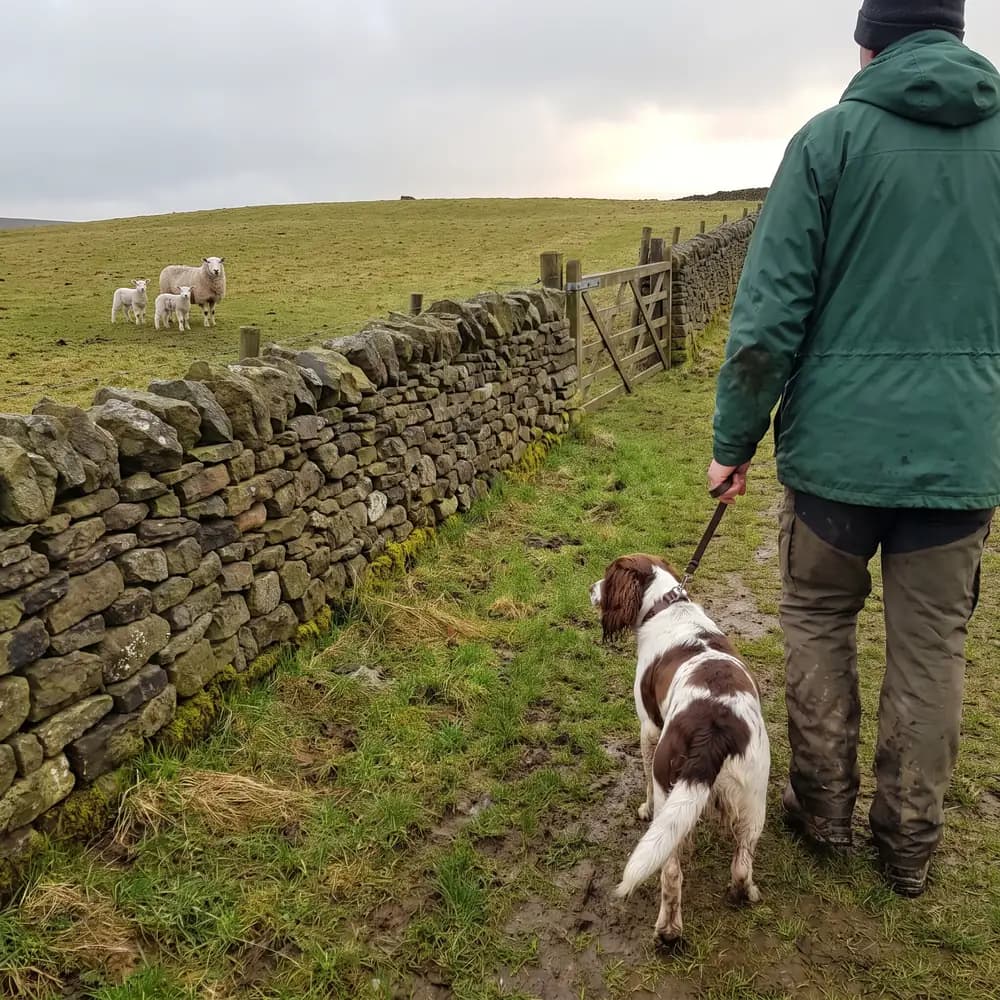
A dog and a field of sheep is the countryside's oldest argument, and the law on it changed this spring. Here is what the law says in each of the three countries the app works in, what the codes ask on top of it, and how the app knows a field is grazed before you get to the gate.
The law in England and Wales
The Dogs (Protection of Livestock) Act 1953 makes it an offence to let a dog worry livestock. Worrying means attacking the animals, chasing them in a way that could injure them or make them lose their young, or simply being at large, which is off the lead and not under close control, in a field or enclosure with sheep in it. You do not have to touch a sheep to break the law. Livestock means cattle, sheep, goats, pigs, horses and poultry. Read 26 September 2026. Dogs (Protection of Livestock) Act 1953.
On 18 March 2026 the Dogs (Protection of Livestock) (Amendment) Act 2025 came into force and widened it. Attacking livestock is now an offence in its own right, separate from worrying. Incidents on roads and paths count, not only those in fields. Alpacas and llamas count as livestock. The penalties went up, and the police gained powers to seize a dog. The Act applies to England and Wales only. Read 26 September 2026. Dogs (Protection of Livestock) (Amendment) Act 2025, section 1 and section 5.
There is a second rule on open access land, the moor, heath, down and common you may cross away from a path. On that ground your dog must be on a fixed lead of no more than two metres near livestock at any time of year, and on a lead of that kind on all open access land from 1 March to 31 July, whether or not there are animals about. The seasonal part does not apply on the coast. Landowners can also shut dogs out of small lambing fields altogether. Read 26 September 2026. Countryside and Rights of Way Act 2000, Schedule 2 and GOV.UK, open access land: rights and responsibilities, updated 6 November 2025.
The numbers
| Rule | When | Law or advice |
|---|---|---|
| Near livestock, access land, England and Wales | All year | Law |
| All open access land, England and Wales | 1 March to 31 July | Law |
| Breeding season, Scotland | Usually April to July | Advice |
What the Countryside Code asks
The Code is advice rather than law, and two lines of it are worth knowing by heart. "It is good practice wherever you are to keep your dog on a lead around livestock." And: "Let your dog off the lead if you feel threatened by livestock or horses. Do not risk getting hurt protecting your dog." Read 26 September 2026, from the version last updated 26 May 2023. The Countryside Code: advice for countryside visitors.
Scotland
Scotland's law starts from the other end. The Land Reform (Scotland) Act 2003 gives everyone a right of responsible access to most land, so a walk may cross a grazed field. But section 9 says the right is not being exercised by anyone "responsible for a dog or other animal which is not under proper control". The right belongs to a walker whose dog is under control and to nobody else. Read 26 September 2026. Land Reform (Scotland) Act 2003, section 9.
The Scottish Outdoor Access Code says what proper control means near farm animals: "Never let your dog worry or attack farm animals", and "Don't take your dog into fields where there are lambs, calves or other young farm animals." Scotland's livestock law was tightened separately by its own Parliament in 2021. Read 26 September 2026. Scottish Outdoor Access Code, dog walking and Dogs (Protection of Livestock) (Amendment) (Scotland) Act 2021.
A walk in Scotland that passes grazing ground says exactly that in the app: keep your dog close near farm animals, and what the Code asks. It never says you have a right to be in the field.
How we know a field is grazed
In England the answer comes from the Crop Map of England, which the Rural Payments Agency publishes every year under the Open Government Licence. It classifies the whole country into about 32 million small hexagonal cells from satellite radar and marks each one as a crop, grassland, woodland, water or built ground. Read 26 September 2026. Crop Map of England on data.gov.uk.
We read the grassland cells. When a walk passes within 40 metres of grassland, the walk says: "Livestock possible. This passes grazing fields, and check-ins confirm or clear it." Every cell carries the map's own confidence in its reading, and we keep that with it, so we can say how sure the grazing estimate is rather than presenting a guess as a fact. Forty metres is wide on purpose. Over-warning costs you a look over the wall. Under-warning costs you the walk.
Wales has no crop map. The grazing reading there comes from an older field survey, so every Welsh reading is marked low confidence. In Scotland it comes from the Habitat Map of Scotland, published by NatureScot.
What it cannot tell you
Grassland is not sheep. The map says a field is grass. It does not say whether anything is grazing it this week, or whether that is sheep, cattle or a horse. One of my three is a border collie, and livestock is the thing I told the app he finds hard, so I know what a field of grass looks like from the gate when you cannot see the far end of it. At sign-up we ask which animals set your dog off most, and we keep the answer, but the map cannot yet tell one from another, so today it is grazing land itself that we steer around.
That is also why we never say "no livestock". A field that reads as grass with nothing in it is a field nobody has looked at. The only thing that can clear it is a walker who was there, which is what a check-in records: livestock in the fields, or no livestock in the fields, with the date they said it. The next walker sees that, and sees how old it is.
Where our data comes from lists every source behind this, with its licence.
Questions this answers
- Is it illegal to let my dog off the lead in a field of sheep?
- Yes, in England and Wales. Under the Dogs (Protection of Livestock) Act 1953 a dog at large, off the lead and not under close control, in a field with sheep is worrying livestock, whether or not it touches one.
- What changed in the law on 18 March 2026?
- The Dogs (Protection of Livestock) (Amendment) Act 2025 came into force. Attacking livestock became an offence in its own right, incidents on roads and paths count, alpacas and llamas count as livestock, and the penalties went up. It covers England and Wales.
- What should I do if cows come towards my dog?
- The Countryside Code says: let your dog off the lead if you feel threatened by livestock or horses, and do not risk getting hurt protecting your dog.
Read next
- What makes a walk hardWalking a reactive dog: the first step out of the doorWhat owners of reactive dogs say they need from a walk, in their own words, what the app asks and checks before it suggests one, and what it cannot know.
- What makes a walk hardCows and dogs: why cattle follow a dog, and what to doCattle see a dog as a threat, most of all cows with calves. What the Health and Safety Executive and the Countryside Code say, and what to do if cows charge.
- What makes a walk hardCan a dog cross a cattle grid?A cattle grid is built to stop animals, and the gaps in its bars do not know a dog from a cow. Where the gate beside it is, and what the law says it is for.