Do dogs have to be on a lead? The law in England, Wales and Scotland
No. In England, Wales and Scotland there is no general law that a dog must be on a lead in public. A lead becomes the law in particular places: a road the council has designated, anywhere a council dog order says so, open access land from 1 March to 31 July and near livestock, and in practice any field with sheep in it.
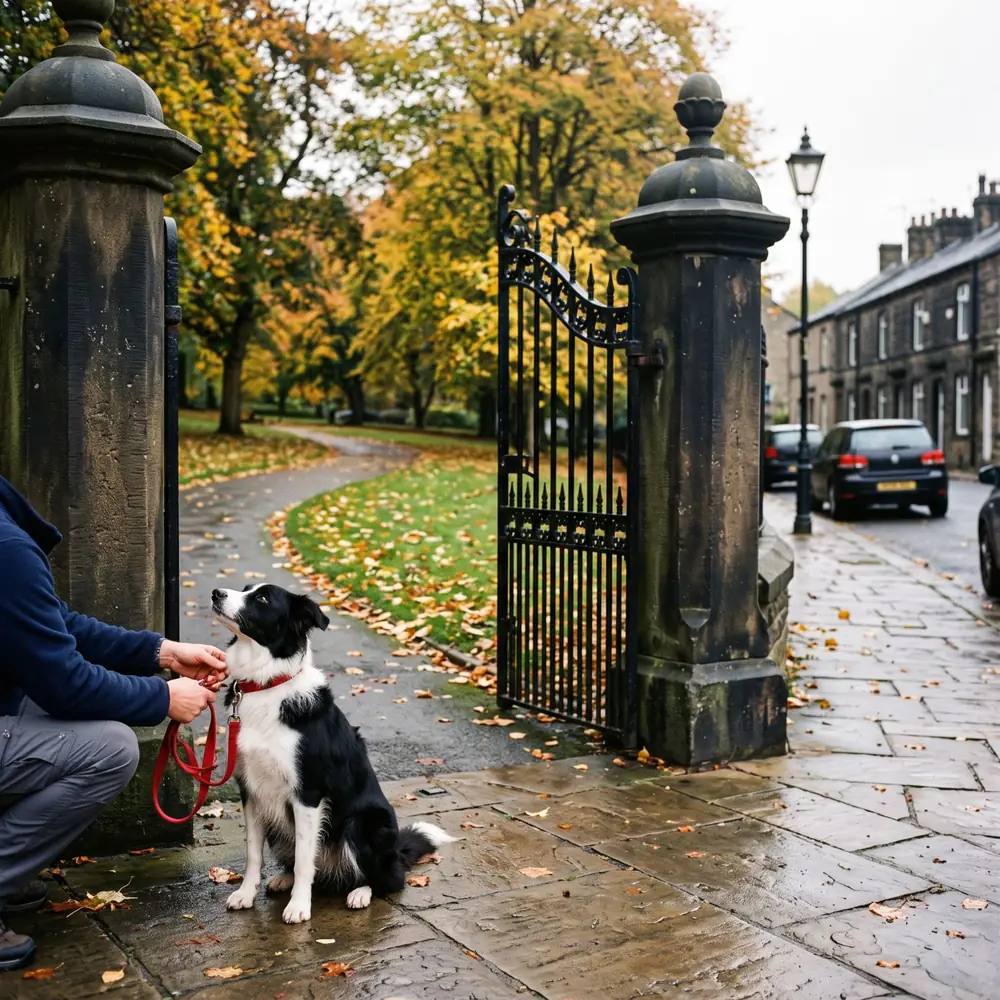
The short answer is no. Nowhere in England, Wales or Scotland is there a law that puts every dog on a lead whenever it is in public. The longer answer is a list of places where a lead is the law, and they are the places a walk tends to cross: a road, a park, open moor, and a field with sheep in it.
Where a lead is the law in England and Wales
On a road the council has designated. Section 27 of the Road Traffic Act 1988 makes it an offence to have a dog on a designated road without holding it on a lead. A road is designated by an order of the council for that area, so most roads are not. Dogs working sheep or cattle, and dogs used under proper control for sport, are exempt. It applies in Scotland too. Read 29 September 2026. Road Traffic Act 1988, section 27.
Wherever a council dog order says so. A council can make a Public Spaces Protection Order that puts dogs on leads in a cemetery, a town centre or a park, or on a lead when an officer asks, or keeps them out of a play area altogether. Breaking one can mean a fixed penalty of up to £100, or a fine of up to £1,000 if it goes to court. Read 29 September 2026. Anti-social Behaviour, Crime and Policing Act 2014, section 67 and section 68. Each council's orders are different, which is why we read them one council at a time. Yorkshire's are in Dogs on leads in Yorkshire.
On open access land, from 1 March to 31 July, and near livestock all year. Open access land is the moor, heath, down and registered common you may wander across away from a path. There your dog must be on a fixed lead of no more than two metres during those months, whether or not there are animals about, and near livestock at any time of year. The seasonal part does not apply on the coast. A landowner can also close access land to dogs, for lambing or on a grouse moor. The rules and the reasons for the dates are in ground-nesting birds.
The numbers
| Where | When | Law or advice |
|---|---|---|
| A road the council has designated | All year | Law |
| A place a council dog order names | As the order says | Law |
| A field or enclosure with sheep in it | All year | Law, in practice |
| Open access land near livestock | All year | Law |
| All open access land | 1 March to 31 July | Law |
| A footpath, bridleway or pavement | All year | Advice |
| Moor, forest, grassland and shore, Scotland | Usually April to July | Advice |
In a field with sheep in it, in practice. The Dogs (Protection of Livestock) Act 1953 counts a dog "at large", meaning off the lead and not under close control, in a field or enclosure with sheep in it as worrying livestock, whether or not it goes near them. Since 18 March 2026 incidents on roads and paths count too. So on a footpath through a sheep field the lead is the only sure way to stay inside the law. The detail is in Dogs near sheep and cattle.
Where it is not the law
A public footpath or bridleway. No law puts a dog on a lead on a right of way as such. The Countryside Code asks you to "always keep your dog on a lead or in sight", to be confident it will come back when called, and to "make sure your dog does not stray from the path". Read 29 September 2026, from the version last updated 26 May 2023. The Countryside Code.
The pavement. Unless the road is designated, a lead on the pavement is advice. Rule 56 of the Highway Code says: "Keep it on a short lead when walking on the pavement, road or path shared with cyclists or horse riders." It carries no legal reference, which in the Highway Code means it is a should rather than a must. Read 29 September 2026, from the version last updated 22 October 2025. The Highway Code, rules about animals.
A park, unless something says otherwise. A park has no lead rule of its own. It has one when a council order or the park's byelaws say so, and a sign at the gate is usually how you find out.
Dartmoor
Dartmoor is asked about by name, so here it is. Its open access land follows the rule above: a fixed lead of two metres or less from 1 March to 31 July, and near livestock all year. The National Park Authority's byelaws for the commons ask for your dog to be under close control and on a lead when a ranger directs it, and the Authority is revising those byelaws. Its own advice goes further than the law and asks for a lead near livestock, through the nesting season, and on warm days when adders are out. Read 29 September 2026. Dartmoor National Park, visiting with your dog and Dartmoor byelaws.
Scotland
Scotland starts from a general right of access, and the right belongs to a walker whose dog is under proper control. There is no general lead law, and public spaces protection orders are an English and Welsh law, not a Scottish one. A lead is still the law on a road the council has designated, and a council can serve a dog control notice on one particular dog that requires it to be on a lead in public. Control of Dogs (Scotland) Act 2010, section 2.
The Scottish Outdoor Access Code asks for more than the law. "During the breeding season (usually April-July) keep your dog on a short lead or close at heel in areas such as moorland, forests, grasslands, loch shores and the sea shore." And in a field of farm animals, a short lead or close at heel, as far from them as you can. Read 29 September 2026, from the version updated 14 July 2025. Scottish Outdoor Access Code, dog walking. The rest is in Dog walking in Scotland.
What the app checks for you
Where we have read a council's dog orders, a walk that crosses a place one of them names says so, and says what the order asks. Where we have not read them yet, the walk says that too, rather than letting the silence read as no rule. A walk that crosses a protected bird site says, from March to July, that leads are on. A walk that passes grazing fields says livestock is possible. And we do not offer a walk that leaves the path across access land a landowner has closed to dogs.
What the app cannot see is a sign on a gate that went up last week, which is why every one of those lines is a reason to look, not a reason to stop looking.
Questions this answers
- Do dogs have to be on a lead by law in the UK?
- Not everywhere. England, Wales and Scotland have no general law that a dog must be on a lead in public. A lead is the law on a road the council has designated, wherever a council dog order says so, and on open access land from 1 March to 31 July and near livestock.
- Do dogs have to be on a lead on a public footpath or bridleway?
- No law puts a dog on a lead on a footpath or bridleway as such. But a dog off the lead and not under close control in a field with sheep in it is worrying livestock under the Dogs (Protection of Livestock) Act 1953, even on the path, and a council order can require a lead on a path it names.
- Does my dog have to be on a lead on the pavement?
- Only on a road the council has designated by order, under section 27 of the Road Traffic Act 1988. The Highway Code asks you to keep a dog on a short lead on a pavement, road or path shared with cyclists or horse riders, but that rule is advice rather than law.
- Do dogs have to be on a lead in Scotland?
- Not by a general law. Access rights in Scotland need your dog under proper control. The Scottish Outdoor Access Code asks for a short lead or close at heel near farm animals, and on moorland, forest, grassland, loch shores and the sea shore in the breeding season, usually April to July.
- Do dogs have to be on a lead on Dartmoor?
- On Dartmoor's open access land, yes, from 1 March to 31 July, on a fixed lead of no more than two metres, and near livestock at any time. The National Park's own byelaws ask for close control and a lead when a ranger directs it.
Read next
- The rules of the groundPheasant shooting season: what it means on a dog walkPheasants may be shot from 1 October to 1 February. A shoot cannot close a public footpath, but it can close access land for a day. What that means with a dog.
- The rules of the groundDogs on leads in Yorkshire: what every council's dog order saysWhat each Yorkshire council's dog control order actually says, read from the sealed orders rather than the web pages, with the dates they run out.
- What makes a walk hardWalking a reactive dog: the first step out of the doorWhat owners of reactive dogs say they need from a walk, in their own words, what the app asks and checks before it suggests one, and what it cannot know.