Dog walks without stiles: why they are hard to find, and how we find them
No ordinary map records a stile. We read the ones volunteers have mapped in OpenStreetMap, count each one within seven metres of a walk, judge them per kilometre, and say where a mapper recorded a dog gate.
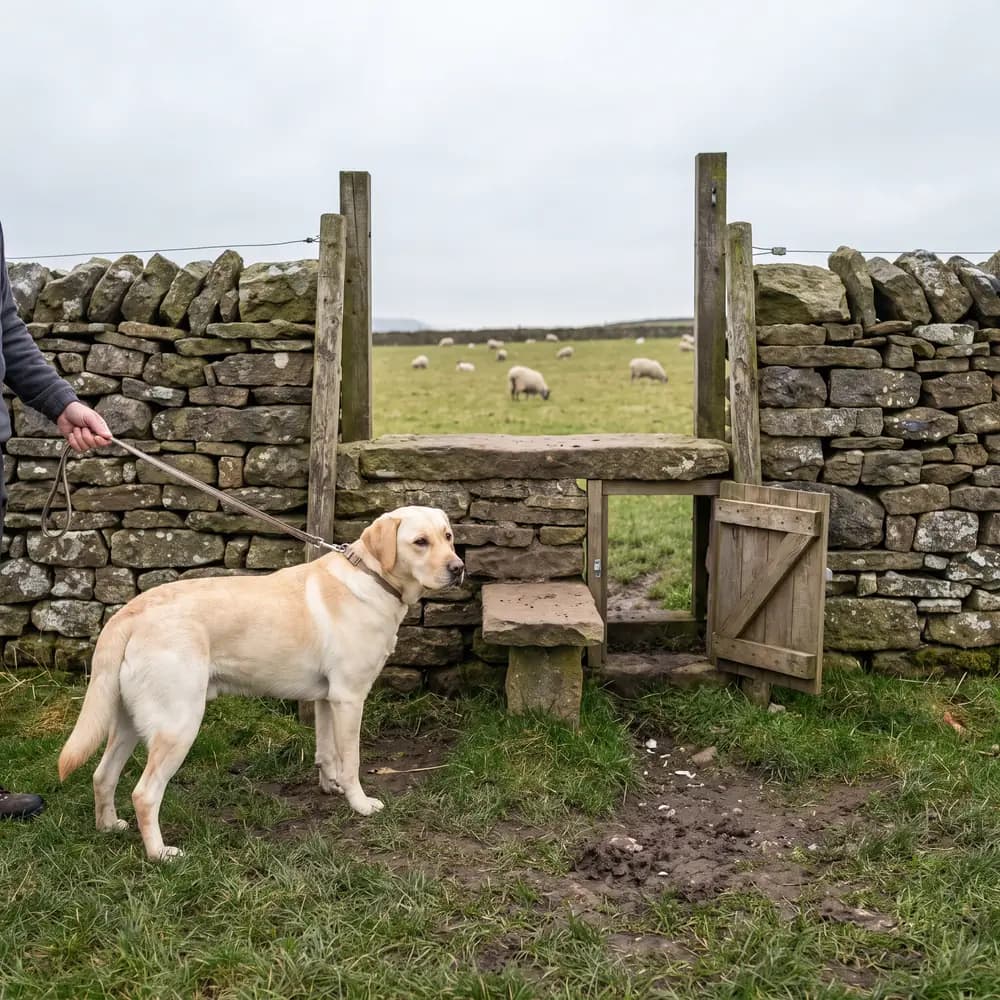
A stile halfway along a footpath is either nothing or the end of the walk, and which one it is depends entirely on whether you can get your dog over it. I have three dogs, and the two Australian Shepherds are not dogs you lift over a wall. For a big dog, an old dog, a dog with a bad back or an owner with one, the stile is the end, and no map I have ever bought would have told me the wall was there. It is one of the first things people tell us stops them, and one of the hardest things to find out before you set off.
Why the maps cannot tell you
An Ordnance Survey map shows the footpath and not what is in the fence. A council's definitive map, the legal record of rights of way, is the same: it says a path exists and says nothing about how you get over the wall at the end of the field. A walk in a guidebook mentions a stile when the writer remembered it. So the one fact that decides whether a walk is possible for you is the fact nobody keeps.
The one public source that records stiles is OpenStreetMap. Volunteers have mapped them one at a time, as a point on the path tagged as a stile, a kissing gate or a cattle grid. Some carry a second tag, dog gate, where the mapper noticed a small flap beside the stile that a dog can go through without being lifted. Read 26 September 2026. OpenStreetMap wiki, the stile tag. OpenStreetMap copyright and licence.
What we count
We read those points from OpenStreetMap for every area it covers and keeps the three kinds a dog walker meets: stiles, kissing gates and cattle grids. It throws away the thousands of gates in towns, the driveway gates, car park barriers and alley gates, by keeping only a barrier within about 45 metres of a field, a park or open access land. A gate on a driveway is not something a walk has to get over.
When a walk is measured, every stile or grid within 7 metres of the line counts as being on it. Seven metres, because a stile is on the path itself, and a wider net would count the stile in the next field along. A kissing gate is counted and shown but never held against a walk, because most dogs walk through one. When you ask for walks without stiles, it is the stiles and the cattle grids we steer around.
Where the mapper recorded a dog gate, the walk says so. The walk's card gives the number, for example three stiles, gates or grids, and if every one of them has a flap it says each has a dog gate. If you asked for stiles to be kept down, the same line says you asked, so you can see why that walk was chosen.
How you tell us
Three questions at sign-up are about this. The first is about you, not your dog: is there anything on the ground that stops you, with stiles and gates as one of the answers. The second asks what to steer around, and stiles and cattle grids are on that list. The third comes later, once we know your dog: could you lift them over a stile if you had to. Easily, it would be a struggle, or no.
The answers do different things. No means we treat stiles as something to steer around when it picks walks. It would be a struggle leaves the walk on offer, with the stile count on the card, so you decide. I would rather show you a walk with one stile and say so than hide it and have you find out at the fence.
A stile is a rate, not a count
A long walk has more of everything. Measured across West Yorkshire on 12 September 2026, walks of about a kilometre and a half carry half a stile on average, and walks of about 27 kilometres carry six and a half. Counting stiles would make every long country walk read as hard going and every short pavement loop read as easy, which is the wrong way round for most dogs. So the app judges stiles per kilometre. Two stiles on a 2 km walk is a different thing from two stiles on 12 km, and we treat it that way.
The numbers
| Typical length | Stiles per walk |
|---|---|
| 1.5 km | 0.5 |
| 5 km | 1.7 |
| 9 km | 3 |
| 12.9 km | 3.7 |
| 19 km | 4.7 |
| 26.7 km | 6.5 |
What we cannot see
Three things, said plainly, because a blank on a map looks like good news and often is not.
A stile nobody has mapped. OpenStreetMap is complete where somebody has walked with a phone in their hand and thin where nobody has. A stile that is missing from the map does not show up as unknown. It shows up as no stile, which reads like an easy path. Before a county goes live we compare its stile count with the counties around it, and a county holding a tenth of what its neighbours hold is treated as a gap in the map rather than as easy ground.
What kind of stile it is. The tag says stile and rarely says which: a couple of steps over a fence, a squeeze between two stones, or a ladder over a head-high wall. Three stiles on a card may be three easy steps or three ladders. And a dog gate is recorded only where a mapper saw one. No tag does not mean no flap; it means nobody wrote it down.
A gap in the wall, a broken fence, a gate with a new padlock on it. None of that is on any map until somebody says so. Every saved walk has a button that reads Tell us what you know, and what you tell us is shown to the next walker with the date you said it.
Where our data comes from lists every source behind this, with its licence.
Questions this answers
- How does Trekosa know a walk has stiles?
- From OpenStreetMap, where volunteers map each stile, kissing gate and cattle grid as a point on the path. A stile within seven metres of the walk's line counts as being on it.
- Do kissing gates count as stiles?
- No. A kissing gate is shown on the walk but never counted against it, because most dogs walk through one. Stiles and cattle grids are what the app steers around when you ask for walks without them.
- Can the app tell what kind of stile it is?
- Rarely. The map usually says stile and no more, so three stiles on a card may be three easy steps or three ladders over a wall. A dog gate is recorded only where a mapper saw one.
Read next
- What makes a walk hardWalking a reactive dog: the first step out of the doorWhat owners of reactive dogs say they need from a walk, in their own words, what the app asks and checks before it suggests one, and what it cannot know.
- What makes a walk hardCows and dogs: why cattle follow a dog, and what to doCattle see a dog as a threat, most of all cows with calves. What the Health and Safety Executive and the Countryside Code say, and what to do if cows charge.
- What makes a walk hardDogs near sheep and cattle: the law when you are walking a dogWhat the law says about dogs near sheep and cattle in England, Wales and Scotland, what changed in March 2026, and how the app knows a field is grazed.