Walking a dog in the dark: when the clocks go back, and what to choose
Yes, you can walk a dog in the dark, and from Sunday 25 October most of us will. The Highway Code asks walkers to wear something reflective after dark and, where there is no pavement, to walk facing the traffic. Pick a walk you know, a short one, or one you can turn round on.
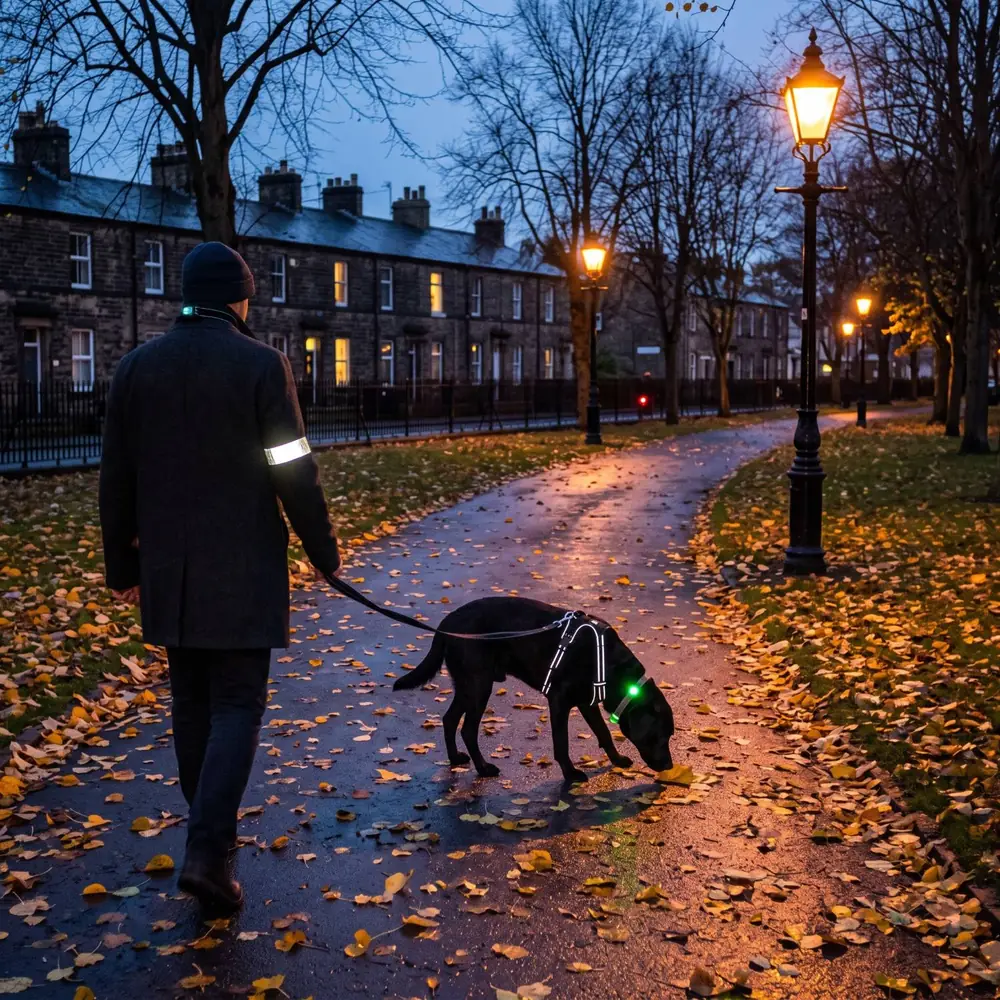
At two in the morning on Sunday 25 October the clocks go back an hour, and the walk after work becomes a walk in the dark until February. In Leeds the sun sets at 17:51 on the Saturday and at 16:49 on the Sunday. By the shortest day it is gone by 15:47. Read 29 September 2026. GOV.UK, when do the clocks change.
The numbers
| Place | Sat 24 Oct | Sun 25 Oct | Mon 21 Dec |
|---|---|---|---|
| Plymouth | 18:09 | 17:07 | 16:15 |
| Cardiff | 18:03 | 17:01 | 16:06 |
| London | 17:51 | 16:49 | 15:53 |
| Leeds | 17:51 | 16:49 | 15:47 |
| Newcastle | 17:49 | 16:47 | 15:40 |
| Inverness | 17:53 | 16:50 | 15:33 |
| Lerwick | 17:32 | 16:30 | 14:57 |
The further north you live, the faster the evenings close in after that. On 25 October Lerwick and Plymouth are 37 minutes apart; by 21 December they are 78 minutes apart.
What the Highway Code asks
There is no law about walking a dog in the dark, and nothing in the Highway Code about the dog. There is advice for the person holding the lead. Rule 3 says: "When it is dark, use reflective materials (eg armbands, sashes, waistcoats, jackets, footwear)". And where there is no pavement, rule 2 asks you to "keep to the right-hand side of the road so that you can see oncoming traffic". Read 29 September 2026, from the version last updated 22 October 2025. The Highway Code, rules for pedestrians.
A lane you walk every summer evening is a different walk in November, because the driver cannot see you until late. All year round we refuse a walk that runs for more than 60 metres beside a 60 mph road with no pavement; why is in busy roads on a dog walk.
Choosing a walk for a dark evening
The walk that works in the dark is usually one of three: one you already know, a short one, or one you can turn round on.
One you know. In the dark you walk the path you remember, not the one on the map. A walk you have done in daylight is the one to keep for the evening.
A short one. More than a third of the walks we have measured, 38 per cent across the country, are under 3 km. Measured 27 September 2026, across about 3.6 million walks.
One you can turn round on. A loop brings you back without repeating a step, and about one walk in seven we have measured is a loop. But in the dark the more useful shape is often a there-and-back, because you can turn for home at any point and the way back is the way you have just walked. When you search, you can ask for the shape you want. The app describes that one as: "Turn round whenever you like."
What we cannot tell you
We cannot tell you whether a path is lit. We do not measure lighting along a walk, so nothing the app says about a walk means it is lit, and nothing means it is not. A walk through streets is usually lit and a walk across fields usually is not, but only a walker who has been there after dark knows.
For a reactive or nervous dog
Plenty of owners of reactive dogs walk in the dark on purpose, because fewer people and dogs are about. When we read what owners said about choosing a walk, how busy a place would be came up in 40 per cent of posts on reactive-dog forums. Quiet is a time of day rather than a place, which is why a check-in records when you went, and why we never call a walk quiet without saying when. More on that in walking a reactive dog.
Questions this answers
- When do the clocks go back in 2026?
- At 2am on Sunday 25 October 2026. Sunset in Leeds moves from 17:51 on the Saturday to 16:49 on the Sunday, and by 21 December it is 15:47.
- Can I walk my dog at night?
- Yes. No law stops you walking a dog after dark. The Highway Code asks walkers to use reflective materials when it is dark and, on a road with no pavement, to keep to the right so you can see oncoming traffic.
- What kind of walk suits a dark evening?
- One you already know, one that is short, or one you can turn round on. A there-and-back walk lets you turn for home whenever you like, which a loop does not. More than a third of the walks we have measured are under 3 km.
Read next
- What makes a walk hardWalking a reactive dog: the first step out of the doorWhat owners of reactive dogs say they need from a walk, in their own words, what the app asks and checks before it suggests one, and what it cannot know.
- What makes a walk hardCows and dogs: why cattle follow a dog, and what to doCattle see a dog as a threat, most of all cows with calves. What the Health and Safety Executive and the Countryside Code say, and what to do if cows charge.
- What makes a walk hardDogs near sheep and cattle: the law when you are walking a dogWhat the law says about dogs near sheep and cattle in England, Wales and Scotland, what changed in March 2026, and how the app knows a field is grazed.