What we mean when we say quiet
Quiet is a time of day, never a property of a place. Every quietness claim in Trekosa names one of six three-hour slots, weekday or weekend, and carries the count of check-ins behind it and the date it was last confirmed.
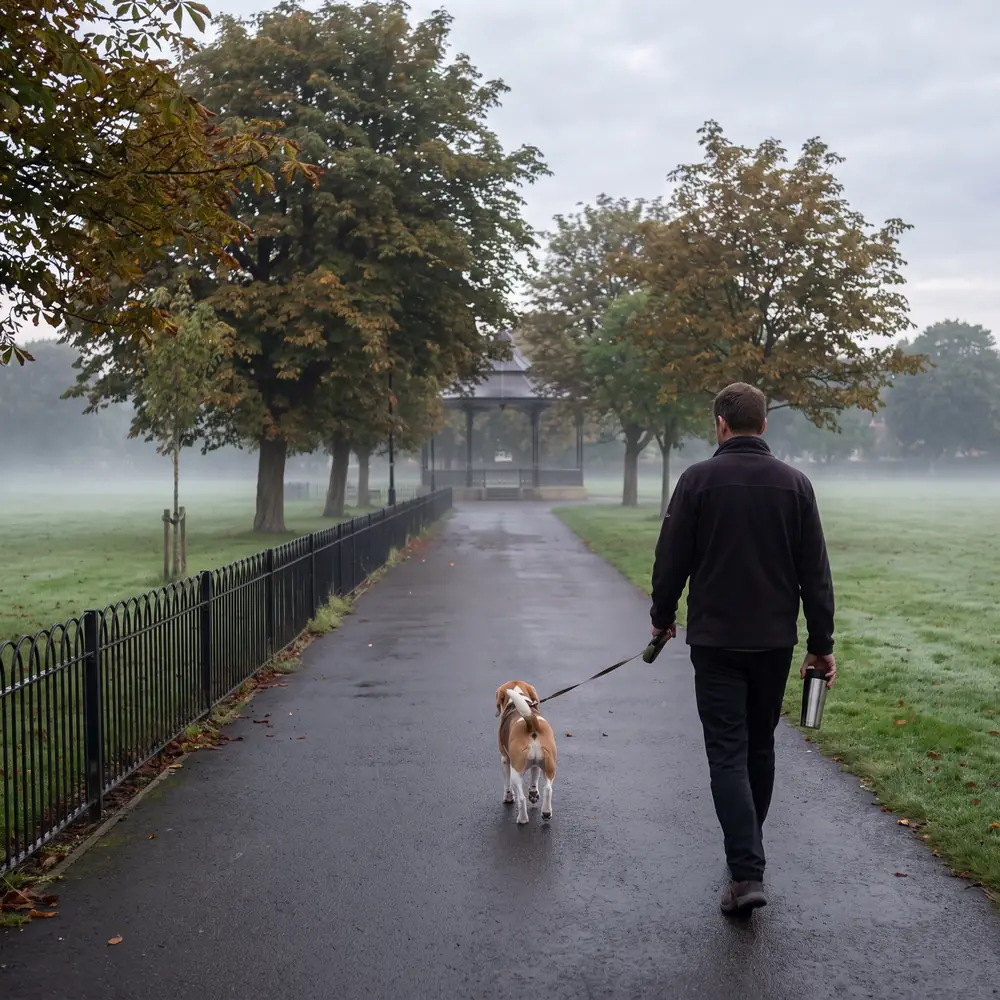
Every walking app in the country will tell you a place is quiet. None of them can know, because quiet is not something a place is. It is something a place is at four o'clock on a Tuesday in February, and something it stops being at eleven on a Sunday in June.
Why the distinction matters
If you walk a dog who cannot meet another dog on a narrow path, the difference between those two visits is the difference between a good week and a setback you spend a fortnight recovering from. A rating out of five cannot hold that. A time can.
So every claim about how busy somewhere is, anywhere in Trekosa, is attached to a time. Not to the walk in general, and never to the place.
The six times
The day is split into six slots of three hours, in UK time: early morning from five to eight, morning from eight to eleven, midday from eleven to two, afternoon from two to five, evening from five to eight, and late evening from eight to eleven. Each is counted separately for weekdays and for weekends and bank holidays. That is twelve answers per walk rather than one, which is coarse enough to fill up from a handful of walkers and fine enough to be worth having. A walk that is calm on a weekday morning and heaving on a Sunday afternoon is not a contradiction. It is the most useful thing anyone could tell you about it.
What a check-in records
After a walk, we ask a few things and writes down exactly what you said, with the date and the slot. How many other dogs were about: none, one or two, a few, lots. How many of those were off the lead. Whether there was livestock in the fields. Whether the path was muddy, blocked or overgrown. Whether it was quieter or busier than you expected. And one thing that stays private to you: how your dog found it, calm, okay or hard work. That last answer never leaves your own screen.
Nothing you say is ever rewritten. If something was wrong, the fix is a fresh check-in, dated. The old one stays as the record of what somebody saw that day.
How the words get stronger
The sentence on a walk is only ever as strong as the evidence behind it. One check-in reads, in as many words, as one check-in: a calm weekday evening, the date, and "early days". Two to four read as an early signal that a slot looks quiet so far. Only at five or more in the last three months does the walk say "walkers report" a slot stays quiet, with the count and the date it was last confirmed beside it.
The badge on a walk works the same way, and the Help page inside the app spells each one out. From the map means the map is our only source so far. Early signal means one or two walkers have reported, which is a start and not a consensus. Confirmed means more than one household has checked in recently. Contested means reports disagree. That second state exists for a reason: a household who reports on their own walk once must not be shown their own report back as though other people had confirmed it.
How a claim ages
A report is worth less every day. In the scoring, a check-in counts half as much after thirty days and a quarter as much after sixty. After 45 days without a fresh report the badge changes to "Needs a fresh report", because things change: a field gets stock in it, a path floods, a school opens next door. A two-year-old "walkers report quiet" is not evidence, and we do not present it as any.
The numbers
| Days since the check-in | How much it counts |
|---|---|
| 0 | all of it |
| 30 | half |
| 45 | the walk asks for a fresh report |
| 60 | a quarter |
| 90 | an eighth |
If you check in on a walk you did a few weeks ago, we date the report at the older end of what you told it, a few weeks back rather than today. That understates how fresh it is, on purpose. Overstating freshness would sell the next walker a stale answer as a current one.
Why we never name a quiet route
You will not find a post here that says a particular path is quiet on Tuesday mornings, and you will not find a ranked list of quiet walks. A published quiet route stops being quiet the week it is published, and the households who told us about it are the ones who lose. So the slot claims live inside the app, on the walks a household has kept, and each person gets a short list chosen for their dog. The next person gets a different one.
Early days, said out loud
Most walks in the app today are from the map alone, and their badge says so. The map can tell you a walk crosses grazing land or runs beside a fast road. It cannot tell you whether the car park fills up at half past nine. Only somebody who was there can, and we say nothing about quiet until they have. That is less satisfying than a green tick. It is also the only version of this that is true, and I would rather give you the true one.
Questions this answers
- How does Trekosa know a walk is quiet?
- Only from walkers who were there. Each check-in records how many dogs were about in a named time slot, and a walk says walkers report a slot stays quiet only after five or more check-ins in three months.
- What does Confirmed mean on a walk?
- More than one household has checked in within the last 45 days. One household's own report reads as an early signal, not as confirmation, so nobody is shown their own report as other people's.
- Why does the app not list quiet walks?
- A published quiet route stops being quiet the week it is published. Quietness lives on the walks a household has kept, and each person gets a short list chosen for their dog.
Read next
- How we knowHow to find an enclosed dog field near you, and what the open map holdsWhere to look for a field you can hire for your dog: the open map, the private directories, your council. What each holds, what is missing and what to check.
- How we knowWhat is an enclosed dog field? What you hire, and what to ask firstAn enclosed dog field is a fenced field you book by the hour so a dog can run off the lead. What you pay for, how it differs from a dog park, and what to ask.
- How we knowIs this walk safe for my dog? Why we will never say yesThe app refuses walks it will not offer, but it never approves one. What it says instead, why that matters for a nervous dog, and what a blank on a map means.